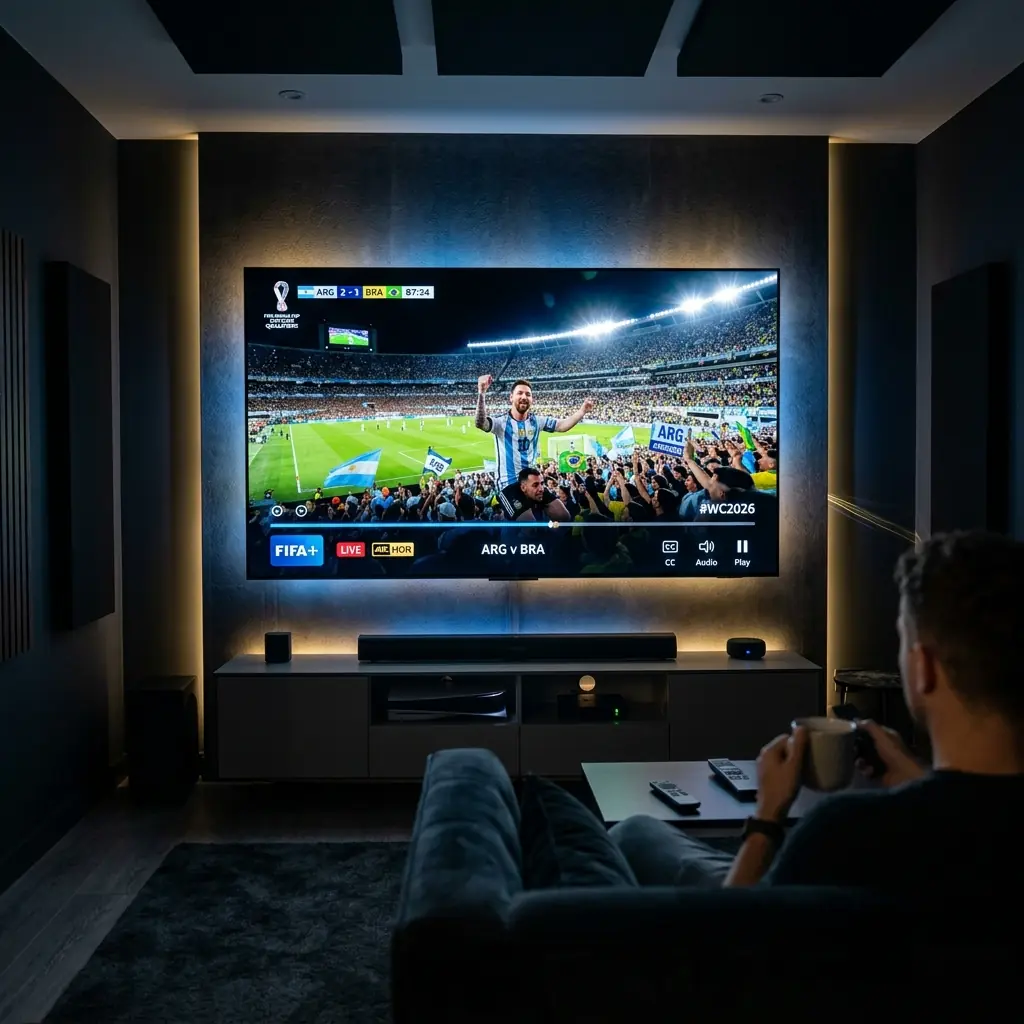
The journey to the biggest sporting event on the planet has begun. As national teams across the globe battle for a coveted spot in the FIFA World Cup 2026, hosted jointly by the United States, Canada, and Mexico, football fans are scrambling to secure the best front-row seats in their living rooms. The World Cup 2026 Qualifiers are set to be the most expansive and competitive in history, with an expanded 48-team tournament meaning more nations have a realistic chance of reaching the final stages. But there is a significant hurdle that millions of fans are facing right now: navigating the fragmented, confusing, and increasingly expensive landscape of regional broadcasting rights to watch these crucial World Cup 2026 Qualifiers.
In the past, you might have been able to rely on a single cable package or one local network to catch all the action. Today, the broadcasting rights for the World Cup 2026 Qualifiers are divided across dozens of different networks, premium subscription services, and geo-blocked streaming platforms. If you want to follow the UEFA groups, track the grueling CONMEBOL South American qualifiers, keep an eye on the rising stars in CAF (Africa) and AFC (Asia), or watch the intense CONCACAF matchups, you would theoretically need half a dozen different subscriptions. This is where Internet Protocol Television (IPTV) completely changes the game.
In this comprehensive, long-form guide, we will dive deep into everything you need to know about streaming the World Cup 2026 Qualifiers. We will break down exactly which networks hold the rights in various regions, identify the top IPTV channels you need to look out for, discuss the technical aspects of 4K streaming, and provide crucial anti-buffering tips to ensure you never miss a goal. Whether you are rooting for Brazil, France, Argentina, England, or an underdog nation making a historic run, this guide will equip you with the knowledge to stream every match seamlessly.
Regional Broadcasting Rights: Who Shows What?
Understanding the broadcasting landscape is the first step to ensuring you have the right channels lined up for the World Cup 2026 Qualifiers. FIFA sells the rights to these qualifiers on a regional basis, meaning the channel broadcasting the matches changes dramatically depending on where you live and which confederation is playing. Here is a detailed breakdown of the major networks that hold the rights across the globe.
UEFA (Europe)
The European qualifiers are always a massive draw, featuring powerhouses like France, Spain, Germany, and England. The broadcasting rights here are fiercely contested. In the United Kingdom, networks like Sky Sports and TNT Sports (formerly BT Sport) dominate the landscape, alongside terrestrial broadcasters like ITV and Channel 4 for England national team games. Across the rest of Europe, networks such as DAZN, Movistar+ (Spain), Canal+ and beIN Sports (France), and RAI (Italy) hold the keys to the kingdom. If you want to watch the entirety of the UEFA World Cup 2026 Qualifiers, you need access to a provider that offers this diverse range of European sports networks.
CONMEBOL (South America)
Often described as the most difficult qualification process in the world, the CONMEBOL World Cup 2026 Qualifiers are grueling, high-altitude battles. Broadcasting these matches is big business. TyC Sports and Televisión Pública are essential for Argentina matches, while Globo and SporTV dominate in Brazil. Across the continent and internationally, networks like beIN Sports en Español, Fanatiz, and Directv Sports carry heavy loads. Finding a service that offers South American sports channels without severe geo-restrictions is critical for fans of Latin American football.
CONCACAF (North America, Central America, Caribbean)
With the USA, Canada, and Mexico automatically qualified as hosts, the CONCACAF World Cup 2026 Qualifiers focus on the remaining nations fighting for the expanded spots. In the United States, rights are split between CBS Sports (Paramount+), Fox Sports, and TUDN for Spanish-language coverage. In Mexico, Televisa and TV Azteca are the main players, while OneSoccer covers the Canadian perspective. Fans need access to comprehensive North American sports packages to catch these regional clashes.
CAF (Africa) & AFC (Asia)
The African and Asian qualifiers feature incredible passion and rapidly developing footballing nations. For CAF World Cup 2026 Qualifiers, SuperSport (based in South Africa) is the undisputed king of broadcasting, covering almost every crucial match across the continent, alongside local channels like ON Time Sports (Egypt) and Arryadia (Morocco). In Asia, the AFC qualifiers are heavily covered by the beIN Sports network across the MENA region, while in East Asia, networks like Coupang Play (South Korea) and DAZN (Japan) hold the rights. Accessing these channels traditionally outside their home regions is virtually impossible without specialized setups.
Top IPTV Channels for World Cup 2026 Qualifiers
When selecting a streaming setup to watch the World Cup 2026 Qualifiers, you need to ensure your service provides access to specific global channels. A robust sports package should categorize channels logically by region and language. Here is a curated list of the absolute must-have channels categorized by language and region to ensure you never miss a kickoff.
Essential English-Language Channels
- Sky Sports Main Event & Premier League (UK): Essential for top-tier European clashes and home nations.
- TNT Sports 1-4 (UK): Covers a wide array of European qualifiers and international friendlies.
- ESPN & ESPN2 (USA/Global): Crucial for global coverage, including select CONCACAF and UEFA matches.
- Fox Sports 1 & 2 (USA): A major rightsholder for international tournaments and qualifiers in the US market.
- SuperSport Premier League & Football (South Africa): The best English-language commentary for all African (CAF) World Cup 2026 Qualifiers.
- beIN Sports English (MENA/Global): Excellent coverage of AFC and select European matches with top-tier English commentary.
Essential Spanish-Language Channels
- Movistar Liga de Campeones & Movistar Deportes (Spain): The premier destination for Spanish fans watching the UEFA qualifiers.
- TUDN & Univision (USA/Mexico): Critical for CONCACAF qualifiers and intense North American rivalries.
- TyC Sports (Argentina): The absolute best coverage of Lionel Messi and the Argentine national team's journey.
- SporTV (Brazil): Although Portuguese, it is essential for South American football coverage, particularly the Brazilian national squad.
- Directv Sports (Latin America): Broad coverage of the CONMEBOL World Cup 2026 Qualifiers.
Essential French & Arabic Channels
- Canal+ Sport & Canal+ Foot (France): Premium coverage of the French national team and major UEFA matchups.
- beIN Sports 1-3 (France): Comprehensive coverage of international football across Europe and Africa.
- RMC Sport (France): A great alternative for European competitions and qualifiers.
- beIN Sports Premium 1, 2, 3 (MENA - Arabic): The undisputed heavyweight for Arabic commentary, covering almost all AFC qualifiers, major UEFA matches, and CAF showdowns.
- SSC Sports (Saudi Arabia): Rapidly expanding coverage of Asian qualifiers and international events.
Match Schedule vs Broadcaster (Example Guide)
To give you an idea of how fragmented the landscape is, here is an example table showing how different high-profile World Cup 2026 Qualifiers are distributed across various global broadcasters. Having all these channels in one place is the ultimate goal.
| Matchup (Qualifier Type) | UK Broadcaster | US Broadcaster | Local/Regional Broadcaster |
|---|---|---|---|
| England vs Italy (UEFA) | Channel 4 / Sky Sports | Fox Sports | RAI 1 (Italy) |
| Argentina vs Brazil (CONMEBOL) | Premier Sports | Telemundo / TUDN | TyC Sports (Arg) / SporTV (Bra) |
| Nigeria vs South Africa (CAF) | Sky Sports (Select) | beIN Sports | SuperSport (Africa) |
| Japan vs Australia (AFC) | TNT Sports | Paramount+ | DAZN (Jap) / Channel 10 (Aus) |
| Mexico vs Costa Rica (CONCACAF) | N/A | Univision / TUDN | Televisa (Mex) |
Technical Quality: The Importance of FHD, 4K, and 60fps
Watching the World Cup 2026 Qualifiers is not just about finding the right channel; it is about the viewing experience. Sports broadcasting pushes streaming technology to its absolute limits. Unlike movies or TV shows, live football features fast-moving action, panning cameras, and dynamic lighting conditions. This is why technical quality matters more than ever.
Standard Definition (SD) is Dead: In 2026, watching sports in SD is unacceptable. The blurriness makes it impossible to track the ball, read player numbers, or enjoy the visual spectacle of modern stadiums.
Full High Definition (FHD 1080p): This is the baseline standard for any decent streaming service. FHD provides crisp, clear images that are perfect for standard televisions and mobile devices. However, resolution is only half the battle; framerate is equally crucial. A stream locked at 30 frames per second (fps) will look jittery when the camera pans quickly. For sports, 50fps or 60fps is absolutely mandatory to ensure the ball glides smoothly across the pitch without ghosting or stuttering.
4K Ultra High Definition (UHD): If you have invested in a modern TV, 4K is the holy grail of sports broadcasting. The World Cup 2026 Qualifiers are increasingly being captured and broadcast in native 4K. With four times the pixels of 1080p, 4K streams offer unprecedented detail—you can see the blades of grass, the sweat on the players' brows, and the intricate details of the stadium architecture. When combined with High Dynamic Range (HDR) for better color contrast and 60fps, 4K streaming delivers a stadium-like experience right in your living room.
However, 4K streaming requires significant bandwidth and a highly stable server infrastructure from the provider. If the backend servers are weak, a 4K stream will simply result in endless buffering, completely ruining the World Cup 2026 Qualifiers experience.
Anti-Buffering Tips: Ensuring a Flawless Stream
There is nothing more frustrating than your screen freezing just as a striker is about to take a penalty kick in a crucial World Cup 2026 Qualifiers match. Buffering is the enemy of live sports. While having a high-quality provider is the first step, there are several crucial technical adjustments you must make on your end to guarantee a flawless, anti-buffer experience.
1. The Golden Rule: Ethernet over Wi-Fi
No matter how fast your Wi-Fi router claims to be, wireless signals are susceptible to interference from walls, microwaves, and neighboring networks. Wi-Fi connections suffer from packet loss and micro-fluctuations in speed. For live, high-bitrate streaming (especially 4K), stability is more important than raw speed. Always connect your streaming device directly to your router using a Cat6 or Cat8 Ethernet cable. This single change eliminates 90% of local buffering issues.
2. Internet Speed Requirements
Ensure your internet package is up to the task. For standard HD (720p), you need a stable 10 Mbps. For Full HD (1080p at 60fps), you should aim for a rock-solid 25-30 Mbps. If you are planning to stream the World Cup 2026 Qualifiers in 4K, you need an absolute minimum of 50 Mbps, though 100 Mbps or higher is highly recommended to account for network overhead and other devices in your home.
3. Defeating ISP Throttling with a VPN
Internet Service Providers (ISPs) are known to intentionally slow down (throttle) your connection when they detect heavy streaming traffic, particularly during massive live events like the World Cup 2026 Qualifiers. They do this to manage network congestion. The result? Sudden, inexplicable buffering right at kickoff. To bypass this, you must use a high-quality, optimized Virtual Private Network (VPN). A VPN encrypts your traffic, meaning your ISP cannot see *what* you are streaming, preventing them from throttling your connection. Connect to a VPN server geographically close to you to minimize latency while maintaining high speeds.
4. Optimize Your Streaming App Settings
Ensure your application's buffer size is optimized. In apps like Tivimate or Smarters Pro, you can adjust the network buffer size. If you have a fast connection, keeping the buffer 'Normal' is fine. If your connection is slightly unstable, increasing the buffer size to 'Large' or 'Extra Large' will force the app to download more of the video in advance, smoothing over temporary internet hiccups.
Device Compatibility: Choosing the Right Hardware
Your streaming experience is only as good as the hardware you use to process it. While smart TVs have built-in apps, they often lack the processing power required to decode high-bitrate 4K streams smoothly over long periods. For the best experience watching the World Cup 2026 Qualifiers, dedicated streaming boxes are highly recommended.
Amazon Firestick 4K Max: This is arguably the most popular and cost-effective device on the market. It supports Wi-Fi 6 for better wireless stability and has a powerful enough processor to handle complex streaming apps with ease. For a detailed breakdown of how it compares to premium hardware, check out our [Insert Link Here] guide.
Samsung and LG Smart TVs: If you prefer a clean setup without extra dongles, modern Samsung (Tizen) and LG (webOS) TVs are capable, provided you use optimized applications. Setting up the software correctly is vital to avoid store restrictions and ensure 4K compatibility. Learn the exact steps in our comprehensive [Insert Link Here] tutorial.
Apple TV 4K: For users embedded in the Apple ecosystem, the Apple TV 4K offers unmatched processing power and a buttery-smooth interface. The A15 Bionic chip ensures that switching between World Cup 2026 Qualifiers matches is instantaneous. For setup instructions tailored to tvOS, read our [Insert Link Here].
Nvidia Shield TV Pro: For the absolute hardcore tech enthusiast, the Nvidia Shield remains the undisputed king. Its AI upscaling makes even 1080p streams look magnificent on a 4K panel, and its gigabit ethernet port guarantees zero local bottlenecking.
The Evolution of Sports Broadcasting: Why Streaming is the Future
To fully appreciate the necessity of modern streaming solutions for the World Cup 2026 Qualifiers, it is important to understand how rapidly sports broadcasting has evolved. Decades ago, international football was restricted to a handful of terrestrial channels. If your national broadcaster did not secure the rights, you simply did not watch the game. The advent of satellite television in the 1990s and 2000s broke down some of these borders, allowing premium subscribers to access a wider array of matches. However, this era was defined by exorbitant costs and long-term, inflexible contracts.
Today, the paradigm has shifted entirely toward IP-based delivery. The World Cup 2026 Qualifiers represent the pinnacle of this shift. Broadcasters realize that fans are no longer content with localized coverage; they want global access. They want to watch the tactical brilliance of European qualifiers on a Tuesday, followed by the raw passion of South American qualifiers on a Wednesday night. Streaming technology is the only infrastructure capable of delivering this level of customized, on-demand global access. The transition to 4K broadcasting over IP networks also means that the visual fidelity available to the average fan now surpasses what was once only possible in professional broadcasting studios.
Furthermore, the interactivity offered by modern platforms—such as multi-cam angles, real-time statistics overlays, and alternative audio feeds—has transformed passive viewing into an immersive experience. As we look toward the World Cup 2026 Qualifiers and beyond, it is clear that traditional linear television simply cannot compete with the flexibility, quality, and comprehensive coverage provided by advanced streaming networks.
Analyzing the Toughest Qualification Routes
When you are setting up your streams for the World Cup 2026 Qualifiers, you will want to focus on the most competitive regions. While the expansion to 48 teams means more nations will qualify, it has not necessarily made the path easier for everyone. In UEFA, the sheer depth of talent means that even traditional powerhouses can find themselves in perilous playoff situations if they drop points against supposedly weaker opponents. The tactical battles in the European qualifiers are a must-watch for any serious football tactician.
Meanwhile, in CONMEBOL, the World Cup 2026 Qualifiers remain a brutal marathon. Teams must navigate extreme variations in climate and altitude—from the suffocating heat of Barranquilla to the dizzying heights of La Paz. Every single point is a massive achievement. Watching these matches requires a reliable stream because the drama often unfolds in the dying minutes of chaotic, physical encounters. Ensuring you have access to dedicated Latin American sports channels will guarantee you capture the true essence and intensity of South American football.
In the AFC and CAF regions, the expanded tournament has injected massive hope and unprecedented investment into national programs. Nations that previously viewed qualification as a pipe dream are now fiercely competitive. The passion of the crowds in places like Algiers, Tehran, and Dakar creates a spectacular atmosphere that translates beautifully on a high-quality 4K stream. Tracking these developing narratives is one of the most rewarding aspects of following the global World Cup 2026 Qualifiers.
Detailed FAQ: Streaming the Qualifiers
1. Are all World Cup 2026 Qualifiers broadcast in 4K?
Not all of them. High-profile UEFA matches (like England vs Germany) and major CONMEBOL fixtures (like Argentina vs Brazil) are frequently produced in native 4K. However, qualifiers in smaller nations or less developed regions may only be available in 1080p or 720p depending on the local broadcasting infrastructure.
2. Why does my stream lag exactly when a goal is scored?
This is a classic symptom of server overload. When a massive event happens (like a penalty in a World Cup 2026 Qualifiers match), thousands of users might simultaneously tune in or interact with the stream, causing a spike in server requests. Premium providers use advanced load-balancing and Anti-Freeze technology across multiple global servers to mitigate this, whereas cheaper services instantly crash under the weight of the traffic.
3. Do I absolutely need a VPN to watch the matches?
While not strictly mandatory for the service to function, using a VPN is highly recommended for two reasons: privacy and performance. As mentioned, ISPs throttle traffic during big games. A VPN bypasses this throttling, ensuring a much smoother, uninterrupted experience.
4. Can I watch multiple matches at the same time?
Yes, but it depends on your app and hardware. Apps like Tivimate offer a "Multi-view" feature, allowing you to watch 2, 3, or even 4 World Cup 2026 Qualifiers matches simultaneously on a single screen. Be warned: streaming four 1080p feeds at once requires a very fast internet connection (100Mbps+) and a powerful device like an Nvidia Shield.
5. How do I fix Audio/Video sync issues during a live game?
If the commentary is ahead of the video (or vice versa), it is usually a decoding issue on your device. Most premium streaming apps allow you to switch the video decoder from Hardware (HW) to Software (SW) or vice versa. Additionally, you can utilize the "Audio Offset" feature in apps like VLC or Tivimate to manually sync the sound by adjusting the delay in milliseconds.
6. What happens if a channel goes down during a crucial qualifier?
No broadcast is 100% immune to technical faults, even traditional cable. The advantage of a comprehensive streaming setup is redundancy. If Sky Sports UK goes down, a premium provider will give you access to the exact same match on beIN Sports English, Fox Sports, or a localized channel like Movistar. Always know your backup channels before kickoff.
The road to North America 2026 is paved with incredible footballing moments. Don't let geo-blocks, expensive contracts, and buffering screens ruin your experience. Upgrade your setup today and experience the beautiful game exactly as it was meant to be seen.
Experience the Qualifiers in True 4K
To truly enjoy the intensity of the World Cup 2026 Qualifiers, you need a service built for live sports. This means access to thousands of global channels, zero buffering, and native 4K quality. For a premium, unthrottled streaming experience, we highly recommend trying out ottocean. They offer dedicated Anti-Freeze technology and server stability specifically optimized for major sporting events.
Don't wait until the next big match kicks off and the servers are flooded. Prepare your setup now and see the difference for yourself. Click the link above or use the button in our header to start your 24-hour Free Trial today and catch every tackle, goal, and triumph of the World Cup 2026 Qualifiers in pristine quality.